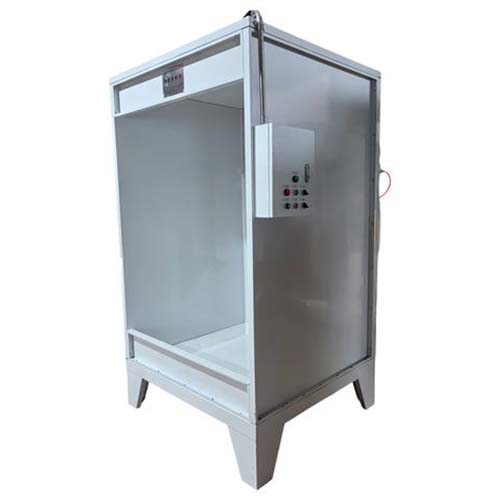
Spray Booth For Powder Coating equipment meets diverse industrial demands by providing controlled environments for applying durable, high-quality finishes. Market demand spans from small custom workshops to large-scale automotive production lines, driven by the need for eco-friendly, cost-effective finishing solutions that eliminate VOC emissions. Pricing reflects this range, with basic manual booths starting around $8,000 to $15,000, semi-automated systems costing approximately $50,000 to $150,000, and fully automated, high-volume industrial lines requiring an investment of $500,000 or more. The operational cost-efficiency is significant, as modern systems can recycle over 95% of overspray powder, reducing material waste and contributing to a return on investment within 2-3 years for high-volume users.
Spray Booth For Powder Coating Project Introduction
Spray Booth For Powder Coating projects involve the application of dry, electrostatically charged powder onto a grounded workpiece within an enclosed chamber. These projects are fundamental across industries such as automotive, aerospace, architectural metalwork, and appliance manufacturing. A typical project workflow starts with part preparation and moves through the spraying, curing, and cooling stages. The core objective of using a Spray Booth For Powder Coating is to achieve a uniform, durable, and corrosion-resistant finish while maximizing powder material efficiency through advanced recovery systems. For custom shops or specific applications like coating motorcycle frames or agricultural equipment, a booth size of approximately 10 feet long, 6 feet wide, and 7 feet high is often adequate. Automated conveyor systems within these booths can process over 100 parts per hour, making them ideal for mass production.
Spray Booth For Powder Coating Surface Treatment Technology Characteristics
Spray Booth For Powder Coating technology is defined by its electrostatic application process and integrated surface treatment. The process relies on electrostatic deposition (ESD), where powder particles are charged as they exit a spray gun—typically a Corona, Tribo, or Rotary Bell type—and are attracted to the electrically grounded workpiece. This ensures efficient wrap-around coverage and strong adhesion. The surface treatment technology within a professional Spray Booth For Powder Coating operation follows a critical three-phase sequence: pretreatment, powder application, and curing. Pretreatment involves thorough chemical cleaning or sandblasting to remove oils and contaminants, which is absolutely essential for finish quality and longevity. Inside the booth, airflow systems are meticulously calibrated to contain overspray and maintain a clean working environment. The final curing phase, usually conducted in a separate infrared or convection oven at specific temperatures, melts and cross-links the powder into a smooth, hard coating. The entire technology stack is designed for zero VOC emissions and produces a thicker, more consistent film than traditional liquid paints without runs or sags.
Spray Booth For Powder Coating Installation Techniques
Spray Booth For Powder Coating installation requires meticulous planning to ensure safety, performance, and compliance. The first technique involves comprehensive site preparation. The floor must be level and possess adequate load-bearing capacity for the equipment, which often includes heavy recovery systems and oven integrations. Sufficient space must be allocated not just for the booth's footprint, but also for operator access, part loading/unloading, and maintenance clearance. Electrical and compressed air supply points must be installed to specification prior to assembly. The second critical technique focuses on the systematic assembly and sealing of the main enclosure. Following the manufacturer's sequence, installers erect the steel or aluminum frame, ensuring all panels are fastened securely to prevent powder leakage. Special attention must be paid to installing and sealing the exhaust ductwork that connects to the external ventilation system. The third technique centers on the integration and calibration of core subsystems. This includes mounting the electrostatic spray guns and powder feeders, connecting the high-voltage power supply with proper grounding, and integrating the powder recovery unit—whether cyclone separator or cartridge filter-based. Final commissioning involves testing the spray gun's atomization, verifying uniform powder adhesion, checking the efficiency of the recovery system, and ensuring the exhaust airflow meets design specifications for safe overspray containment.
Spray Booth For Powder Coating Manufacturing and Production Costs
Spray Booth For Powder Coating manufacturing involves constructing a robust enclosure with integrated mechanical, electrical, and pneumatic systems. Production costs are influenced by scale, material selection, and the level of automation. For a basic manual booth designed for low-volume work, primary costs include the fabrication of a mild steel frame, installation of a standard ventilation fan, basic cartridge filtration, LED lighting, and safety components like grounding systems. The manufacturing cost for such a unit, before markup, underpins the market price of $8,000 to $15,000. As the design complexity increases to include features like high-efficiency particulate air (HEPA) filters, advanced powder recovery systems that achieve high reclaim rates, and explosion-proof electrical fixtures for hazardous environments, material and labor costs rise significantly. The most substantial cost driver is automation. Manufacturing a semi-automated or fully automated Spray Booth For Powder Coating line involves integrating robotic spray arms, programmable logic controller (PLC) systems, synchronized conveyor systems, and sometimes integrated curing ovens. The incorporation of IoT-enabled controls for monitoring performance and energy-efficient ovens with heat recycling further adds to the production expense. These factors collectively justify the wide price range for commercial and industrial systems. It is often more cost-effective for businesses to purchase from a specialized factory rather than attempt self-manufacturing, due to the required engineering expertise, compliance with safety standards, and the economies of scale a factory possesses.
Questions and Answers About Spray Booth For Powder Coating Equipment
How to determine the right size for a Spray Booth For Powder Coating operation?
Determining the right size for a Spray Booth For Powder Coating operation requires evaluating both your largest workpiece and your production workflow. A fundamental rule is to select a booth that is at least 2 feet wider and taller than the biggest part you intend to coat, ensuring sufficient clearance for the spray gun to maneuver and for adequate airflow around the part. For example, coating motorcycle frames may require a booth sized around 10'L x 6'W x 7'H. Beyond part dimensions, consider the production volume. A manual batch booth is suitable for up to 100 parts per day, while a booth designed for an automated conveyor system must be long enough to accommodate the required curing and cooling zones for handling higher volumes per hour. The internal layout of the Spray Booth For Powder Coating, including door placement and the location of the powder recovery system intake, also impacts the effective working space and must be planned accordingly.
How to maintain optimal airflow and filtration in a Spray Booth For Powder Coating?
Maintaining optimal airflow and filtration is a critical routine task for a Spray Booth For Powder Coating. Airflow should be maintained within the manufacturer's specified range to ensure proper overspray containment and operator safety. A drop in airflow usually indicates a clogged filter. Cartridge filters should be cleaned regularly using a reverse-pulse system if equipped, and replaced at regular intervals, or immediately if pressure gauges show a significant increase. Daily inspections should check for powder buildup on filter surfaces, and the exhaust fan should be checked weekly for proper operation. Consistent maintenance of the Spray Booth For Powder Coating filtration system not only protects air quality but also ensures the efficiency of powder recovery, directly impacting material costs.
How to achieve a safe working environment within a Spray Booth For Powder Coating?
Achieving a safe working environment in a Spray Booth For Powder Coating mandates a multi-layered approach focusing on fire prevention, dust control, and personal protection. First, strict static control is non-negotiable; all equipment and workpieces must be properly grounded to prevent sparking that could ignite airborne powder. The booth itself should feature explosion-proof lighting and electrical components, especially when using combustible powders. Second, effective ventilation is crucial to keep the concentration of powder particles below explosive limits and to protect operator respiratory health. Operators must wear approved respirators, anti-static clothing, and safety goggles. Third, a well-enforced housekeeping regimen for the Spray Booth For Powder Coating, including daily vacuuming of spilled powder and safe storage of powder containers in fireproof cabinets, minimizes secondary hazards.
How to select the appropriate powder application gun for a Spray Booth For Powder Coating?
Selecting the appropriate powder application gun for your Spray Booth For Powder Coating depends on the part geometry, production speed, and powder type. The three main gun technologies are Corona, Tribo, and Rotary Bell. Corona guns use a high-voltage electrode to charge the powder and are compatible with virtually all powder types, making them a versatile choice for general use in a manual or automatic Spray Booth For Powder Coating. For parts with deep recesses, a Tribo gun, which charges powder through friction without a high-voltage electrode, can provide better coverage. For high-speed, automated lines such as those in automotive production, Rotary Bell guns are often selected for their high transfer efficiency and large, uniform spray pattern. The choice of gun directly impacts the finish quality and operational efficiency of the entire Spray Booth For Powder Coating system.
How to plan for future expansion when investing in a Spray Booth For Powder Coating system?
Planning for future expansion when investing in a Spray Booth For Powder Coating system requires strategic foresight in the initial selection and design phase. The most effective method is to choose a modular booth design from the outset. Modular Spray Booth For Powder Coating systems allow you to purchase a configuration that meets current needs but can be physically expanded—by adding wall sections, lengthening conveyor lines, or upgrading filtration capacity—as production volumes grow. When selecting equipment, inquire about the scalability of the control system and powder recovery unit. Opting for a recovery system with a higher capacity than initially needed, or a control panel that can accommodate additional robotic arms, provides a straightforward upgrade path. Investing in a robust foundation and utility connections that can support a larger future footprint will also save significant cost and disruption during expansion of your Spray Booth For Powder Coating operation.
links:
Powder Coating Machine
Powder Coating Gun
Powder Coating Booth
Powder Coating Oven
Powder Coating Equipment
Powder Curing Oven
Statement: Hangzhou Huaxiang Coating Equipment Co., Ltd Chinese Powder Coating Equipment facturers provide you with customized equipment for various types of Powder Coating Lines, Powder Coating Ovens, Powder Coating Booths,Powder Coating Guns, etc. For inquiries! Contact us at
Email: gezx@cncolourspray.com
WhatsApp: +86 13335812068